We’ve all been there: sitting down to tackle a task that requires total presence, but your brain just feels like fog. You stare at the screen, move a comma, check your email, and suddenly an hour has vanished.
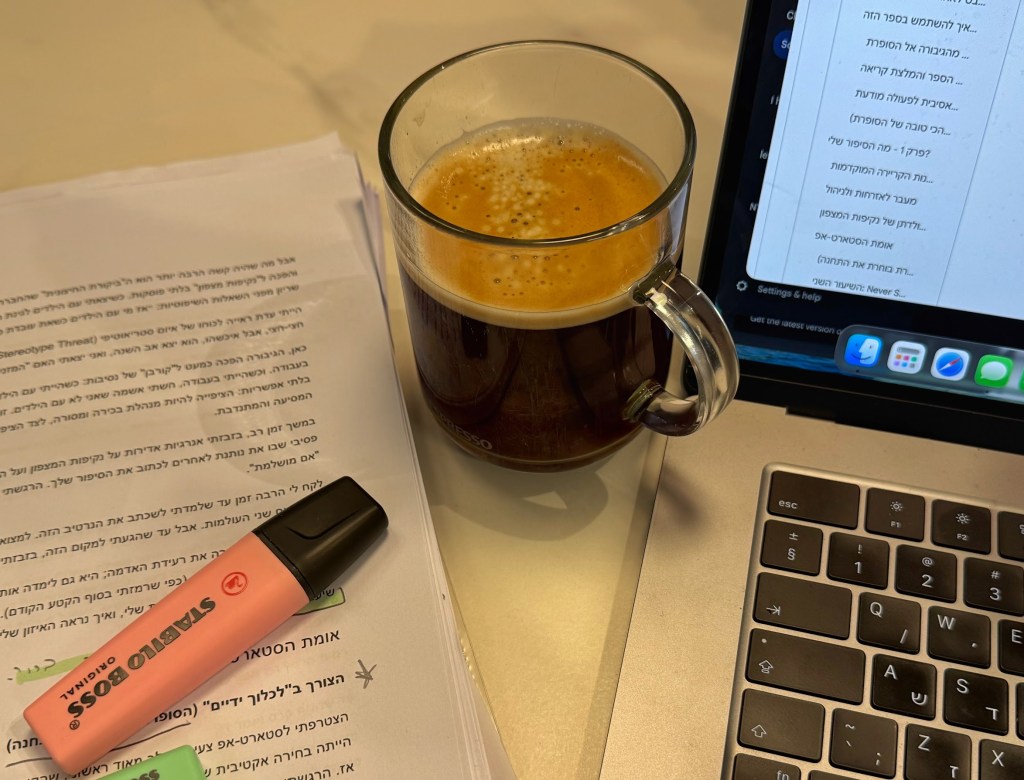
Lately, I’ve been spending my mornings editing my book (you can see my working environment in the photo). As a tech executive, my days are usually a whirlwind of meetings, quick decisions, and constant context-switching. I’m used to high-pressure concentration, but editing is different. It requires a “deep gear”, consistent, focused time alone with no distractions.
I realized I wasn’t lacking the skill to edit; I was lacking the right biological state for that specific type of work.
The Naperville Experiment: Why We Need a “Spark”
I’ve been revisiting the research of Dr. John Ratey in his book Spark. He shares a fascinating story about a school district in Naperville, Illinois, that completely changed how we think about the brain.
The Hypothesis: The school started a program called “Zero Hour PE.” The idea wasn’t just to get kids in shape, but to see if intense physical activity before class would affect their ability to learn.
The Experiment: Instead of traditional gym games, students wore heart rate monitors and performed high-intensity exercise right before their most difficult subjects, like math and literacy.
The Findings: The results were staggering. Naperville became one of the top-performing districts in the world. Dr. Ratey discovered that exercise spikes a protein called BDNF (Brain-Derived Neurotrophic Factor). He describes it as a biological “reset” or high-quality fuel for the brain. It physically prepares our neural circuits to process information and drastically improves our ability to concentrate immediately afterward.
Stacking the Biology with the Habit
Understanding the science was the first step. The second was building a system to use it, which is where James Clear’s Atomic Habits comes in.
Clear’s work is built on the idea that we don’t rise to the level of our goals; we fall to the level of our systems. One of his most effective tools is “Habit Stacking.”
The Hypothesis: It is much easier to start a new behavior if you “anchor” it to something you are already doing.
The Experiment: In my own life, I decided to test this by stacking my most “solitary” task, book editing, directly onto the end of my morning workout. I already walk and run sprints every morning. I knew that when I walked back through my front door, my brain would be flooded with that post-exercise “fuel.”
The Findings: By attaching the editing to the workout, I removed the friction of “starting.” My brain is already “online” and ready for deep focus. The fog is gone, and I can slide into that deep gear much faster than if I had just sat down with a cup of coffee.
Managing Biology, Not Just Time
As leaders, we are taught to manage our calendars and our energy. But I’m starting to think that managing our biology is the real secret to those tasks that require us to be alone with our thoughts.
It isn’t about working “harder” than I do during my tech day; it’s about preparing my brain for a different kind of work.
A question for you: Think about a task you have that requires deep, quiet concentration, the kind where you need to be alone with your thoughts. I’m curious: what would happen if you “stacked” that task immediately after 20 minutes of movement?
I’d love to hear if you notice the fog clearing, too.
 Mor Schlesinger
Leave a comment